Automated polysilicon feedstock handling boosts yield and safety
Project snapshot
Client:
Location:
Sector:
Product type:

Challenge
Handle fragile, heavy polysilicon rods in a hazardous environment
Manual handling of polysilicon rods caused yield loss due to breakage and contamination. Rod diameters varied widely and spacing was tight, creating a mechanical challenge. The manufacturing environment was classified as Class 1, Division II, Group B, requiring strict safety compliance.
Innovation
Precision, contamination-controlled rod handling
We designed and built an automated feedstock handling mechanism that:
- Accommodates wide ranges of rod diameters and small spacing.
- Minimizes particle and metal contamination through material selection and guarding.
- Integrates compactly into existing reactor layouts.
- Meets Class 1, Division II, Group B hazardous area standards.
Result
Improved safety and yield through automated feedstock handling
The automation reduced contamination and breakage, enabling higher manufacturing throughput while ensuring compliance with hazardous area standards. Operators were removed from direct handling, improving overall plant safety.
Featured capabilities:
Featured sectors:
Case studies
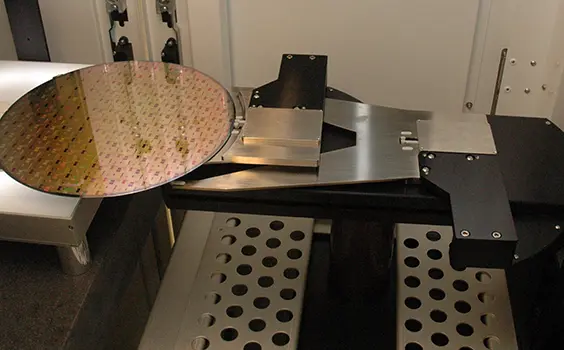
The customer needed to deliver their confocal IR laser scanning technology on a fully automated 300 mm platform. Developing in-house automation would have diverted engineering resources and delayed commercialization….
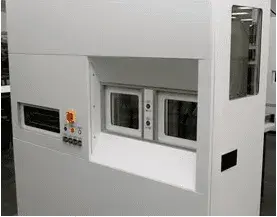
The MoCVD deposition process is critical to HBLED manufacturing, with tightly constrained carrier pockets and strict no-contact requirements on both wafer sides. Manual loading could not meet throughput…
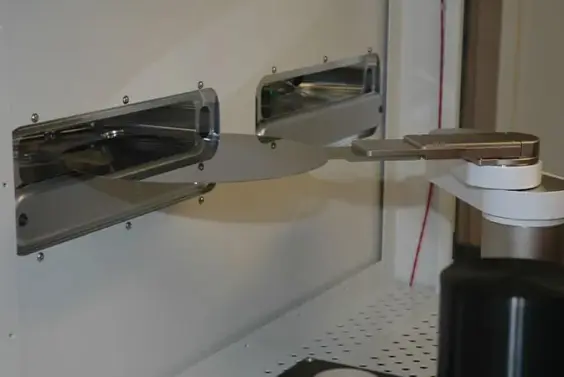
Next-generation process and device technologies demanded new measurement tools, but fabs require fully automated 300 mm configurations for evaluation. Our client needed a high-vacuum wafer automation platform…