Custom vacuum chambers for your oxygen-free, pure gas, or long mean-free-path process
Vacuum chambers are often required when trying to quickly change over from air to an oxygen-free or nitrogen-free environment, or if your process requires a long mean-free-path to minimize molecular collisions. AIR has extensive experience designing custom vacuum chambers and supporting vacuum systems with pumps, sensors, and feedthroughs to support your automated process.
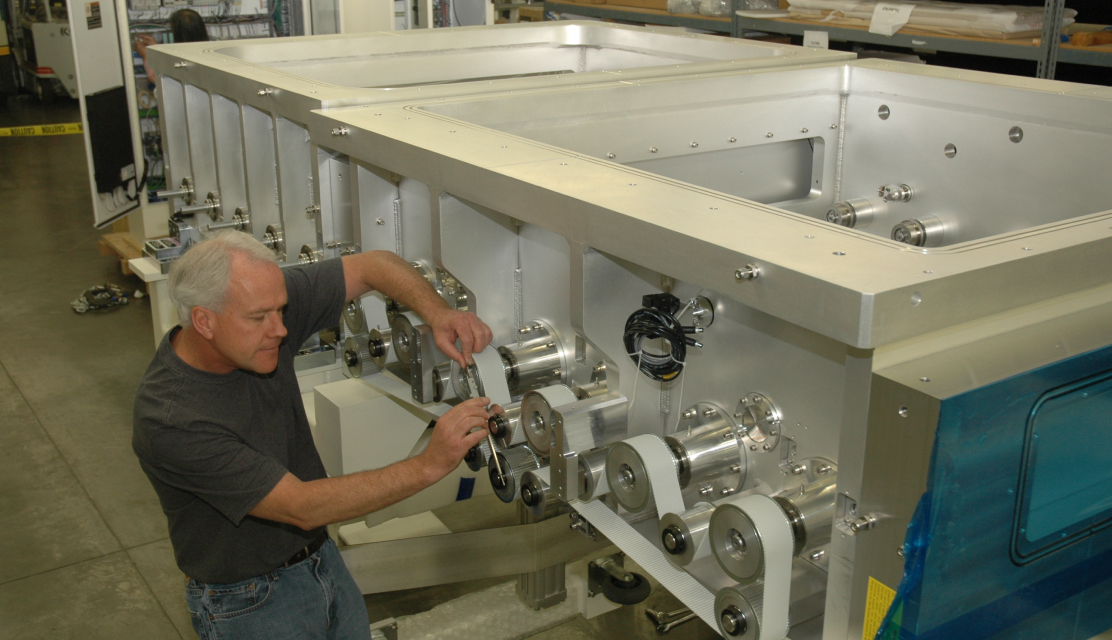
Capabilities
Finding the right direction for your vacuum process
While vacuum chambers exist commercially, AIR can help you determine if an off-the-shelf OEM vacuum chamber is most appropriate for your process, or if you would benefit from a custom design. AIR integrates OEM vacuum chambers and develops optimized solutions for our customers. These are some of our development capabilities:
- Vacuum rangesUp to ultra-high vacuum (10-11 Torr)
- MaterialsMonolithic aluminum chambers or welded stainless steel
- InterfacesBellows, rotary and/or linear feedthroughs, windows, ISO/KF/CF flanges
- Types of chambersLoad locks, transfer modules, process chambers
- Pump selectionRoughing, turbo, getter, cryo
- SensorsMFCS, ion gauge, capacitance manometer, Pirani gauge
- Temperature controlBake-out lamps, water cooling
- VibrationPassive pneumatic and active isolation
- QualityHelium leak check
Approach
Development of the ideal vacuum system begins with a thorough investigation
AIR works with you to determine if an OEM solution exists for your system that meets the cost and/or timeline requirements. In some cases, existing products are the best choice for a system and AIR can help with the selection process and integrating it into the full system. However, in some cases, a custom solution is warranted. This is often dictated by a combination of both deficiencies in lead time and functionality/features of an OEM solution. In this case, AIR has the experience to design a custom vacuum chamber/system to meet your needs and optimize it for performance. Typical criteria for a custom vacuum chamber design:
- Pump down timeMaterial selection, chamber volume, port sizes, and locations
- ServiceabilityMaintenance doors/chamber lid
- Dimensional tolerancesArchitecture to enable maintaining alignment of critical features
- Pump sizingAnd port locations
- Support systemVibration isolation, pedestal
- Thermal controlBake-out or cooling
Impact
Custom vacuum chambers for optimized performance
While generic vacuum chambers can often be a quick path to a prototype, they are rarely the best choice for a production process chamber. Pump down time and maintenance requirements that can impact throughput and uptime often trump the convenience of an off-the-shelf design. Custom chambers have several advantages:
- Minimized chamber volume to reduce pumping time and pump sizing
- Improved service access to internal components
- Optimized pump port locations
- External chamber size and geometry to fit with the remainder of the system
Case studies
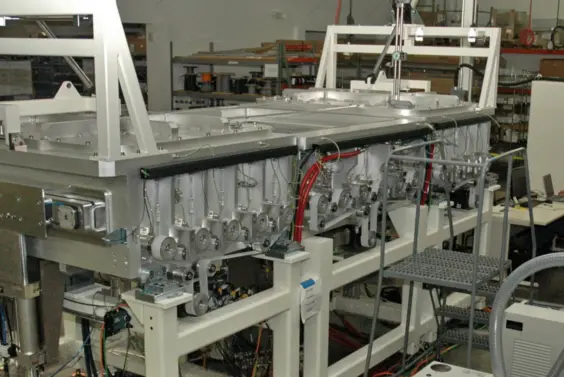
The client needed to move a lab-proven wafer PV process into a high-throughput, production-ready machine for deployment in one of the world’s largest PV factories. Key challenges included maintaining…
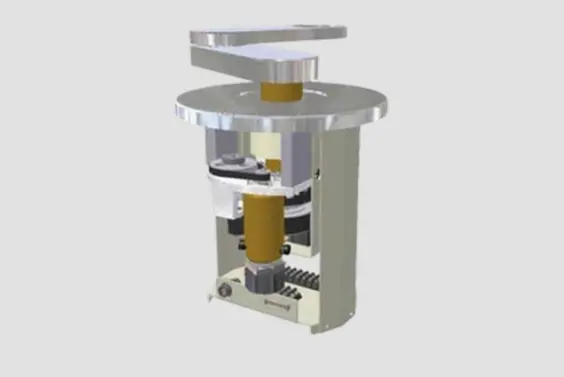
A leading semiconductor automation manufacturer needed to quickly cost reduce their vacuum robot design, which required a total redesign of the mechanisms below the mounting plate. Time was critical as…
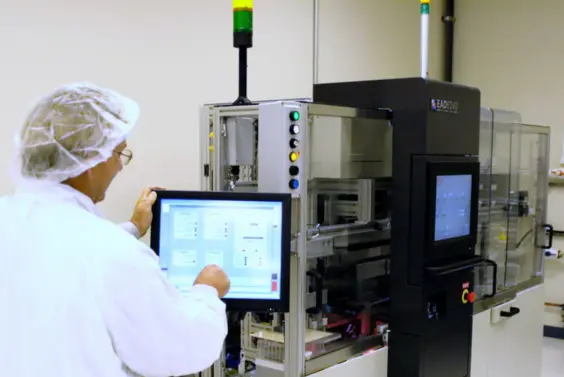
The client needed to convert a lab-demonstrated wafer PV process into a production-ready machine for deployment in one of the world’s largest PV factories. The system had to achieve high throughput while…