5 Custom Factory Automation Sourcing Best Practices
If you’re an end-user manufacturer, why go outside for custom factory automation?
End-users are experts at operating factories, but typically have limited expertise and little interest in designing custom equipment. A few end-users view manufacturing equipment as a competitive advantage and feel they must use in-house equipment design expertise. For these situations, it usually still makes sense to outsource the actual design and build of the equipment to experts while keep the actual process (core IP) in-house.
If you run a factory, your job is to make stuff quickly and cheaply. Where is the strategy behind designing and building your own equipment? What value do all those engineers, technicians, assemblers, and facilities needed to build equipment add to your product? What will those people do after you’re done with building the equipment? All that fixed cost adds to the cost of goods sold (COGS), and for what benefit?
1. Avoid DIY
Yes, we’ve heard it before: “We can do it faster/better/cheaper ourselves.” We make a good living re-working equipment designed internally by factory personnel. Sure, a couple of biochemistry PhDs from Cal could design microfluidic factory equipment, but should they?
In a best case scenario, the equipment will work but require the Ph.D. to run and maintain it. What’s the cost to you of equipment with 60% uptime vs. 90%? What’s the cost of the army of skilled technicians (or Ph.D.s) needed to keep it running?
2. Focus on Your Core Competencies
Ok, as a startup you did what you had to do with whomever was available. But as soon as you get rolling, hire professionals to turn your “engineering prototype” equipment into real production equipment. Factory equipment design is a specialized skill. If you need that skill, hire it when you need it, for only as long as you need it, and focus your energy and resources on doing what you do best: manufacturing your product. Your investors will thank you, because they probably don’t think a factory doing a bunch of non-product engineering is a good use of their money.
How to Find the Right Custom Manufacturing Equipment Partner
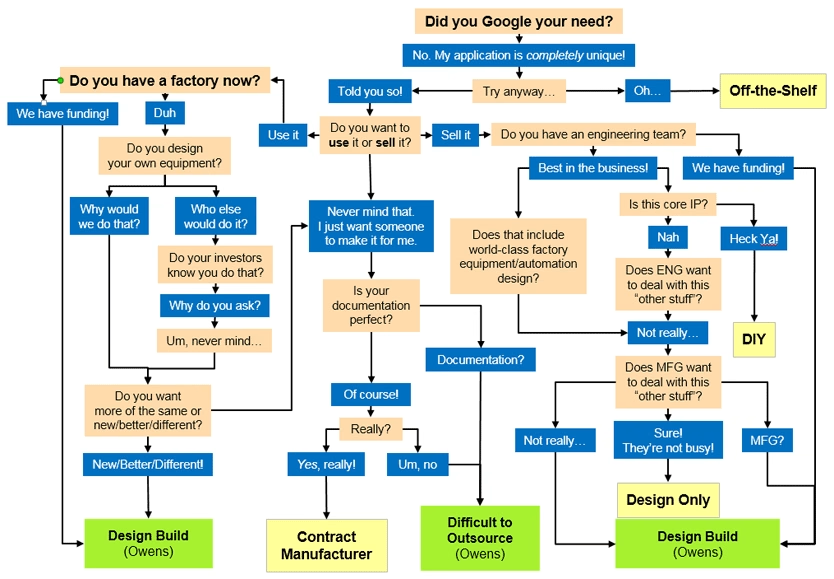
Factory Automation Sourcing
3. Experience Matters
As for supplier selection, cost and schedule are the key variables. But you also want the system to work. The last thing you need is for some low-bid supplier to replace the clever but unreliable system your PhDs build with a different cheap but unreliable system.
Look for suppliers who have hands-on experience with processes and products similar to what you need. Don’t hire your landscaper to remodel your kitchen… And while we’re on the home contractor analogy, prioritize compatibility: do you see yourself able to work closely with them. Do you trust them?
4. First Things First
Do the equipment development in the right order. So many projects fail because the chosen sequence, whether intended or not, is: (1) make it cheap, then (2) make it work. The right answer, of course, is (1) make it work, followed by (2) make it cheap.
5. You Get What You Pay For
If your equipment needs are utterly ordinary except for the form factor of the parts, then going with a low-cost system integrator will likely be the ideal solution. Custom equipment design firms may pass on the job since limited value-add is needed.
Your Guide
Is your application or process unique? Are you in a new field with little or no historical manufacturing precedent? If so, you’ll be better off with a custom equipment design and build firm. They’ll be able to deliver reliable equipment despite novel, challenging or vague requirements. It may seem more expensive but the actual cost is likely much lower by getting it right the first time and avoiding very costly delays in manufacturing.
We’ve written a series of blogs introducing various manufacturing equipment options and the process for determining which is the best for you. Start with the first blog, or read the next blog: Why OEMs Should Outsource Product Design, Build & Manufacturing.
Contact us to learn more about custom automation solutions

Related news & insights
The conversation among manufacturers has moved on from, “should we automate?” to “how do we automate?” Darragh de Stonndún, CEO of Automated Industrial Robotics, says there’s a right and a wrong...
You might have heard of build-to-print manufacturing. Here’s a comprehensive guide on what it is, when to use it, and how it differs from build to spec.
An innovative single-line platform to significantly reduce time-to-market for new medicines