Meet PACE: pharmacy automation for clinical efficiency
An innovative single-line platform to significantly reduce time-to-market for new medicines
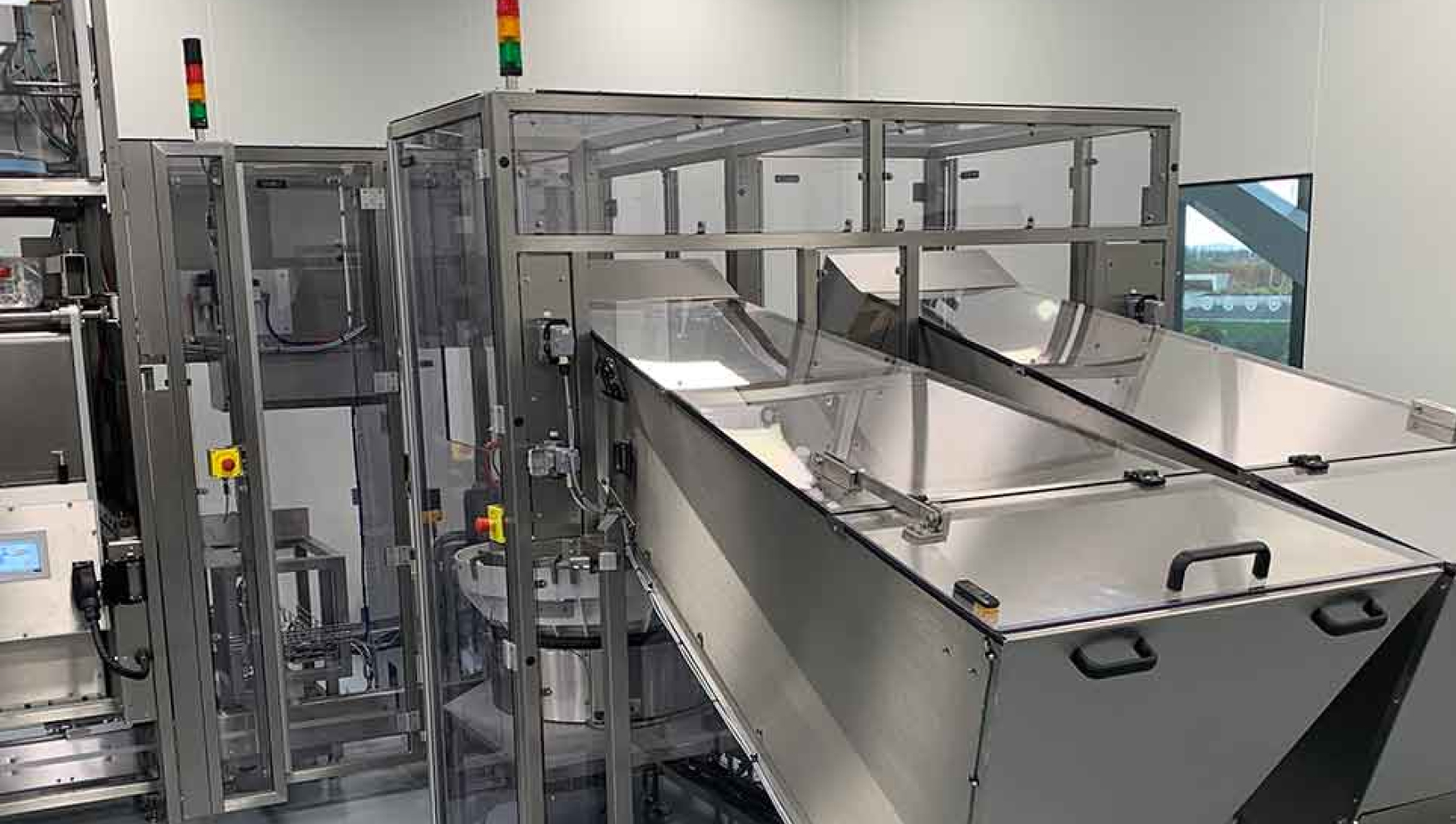
Clinical trials need to be carefully controlled at every stage, which makes them expensive and time-consuming to run. That’s why we’re really excited about PACE. It’s bringing dramatic innovation and advancements to the pharmaceutical industry and can significantly reduce time and costs of clinical trials.
Lee Manning, PACE Business Manager, AIR
PACE is designed to reduce clinical trial timescales from months to just days
Handling › Filling › Sealing › Weighing › Marking › Labeling › Packing
Getting a new medicine from development into a clinical trial takes time. Every drug type typically needs its own dedicated line and cleanroom, which limits flexibility and adds cost and time before a single patient sees the product.
Pharmacy automation for clinical efficiency (PACE), AIR’s platform for clinical trial drug processing, was built to solve that problem.
PACE handles production, packaging, and labeling for multiple drug types on one line, in a single GMP-compliant cleanroom, with full traceability and no cross-contamination risk between products.
This helps create a more demand-driven, responsive clinical supply chain. PACE is designed to help pharma companies cut waste, lower cost, and get trial medicines to patients faster than the traditional single-drug, single-line model allows.
How PACE works
PACE is built around a set of independent, modular filling stations, each individually monitored for humidity and temperature.
Because each station operates as its own discrete unit, different drug types can be processed within the same cleanroom without the risk of contamination between them. The result is a station that can be removed for decontamination and swapped back in when the drug type changes, without redesigning the line.
The platform currently supports tablets and capsules, with additional filling station types achievable as needs develop. Every bottle is tracked from bulk feed through to dispatch:
- Bottles are marked with 2D matrix codes and scanned at each stage for full traceability
- Precision weighing checks accuracy at three points in the fill process
- Induction sealing and torque-controlled capping are digitally logged bottle by bottle
- In-line, camera-verified labeling removes manual labeling errors
- A web-based QP dashboard gives quality personnel real-time access to verified process data, so batch releases can be reviewed and authorized faster
The system’s architecture is scalable: hopper capacity, filling stations, and storage can all be increased without a full system redesign.
This means PACE can grow alongside a trial’s needs rather than being replaced by them.
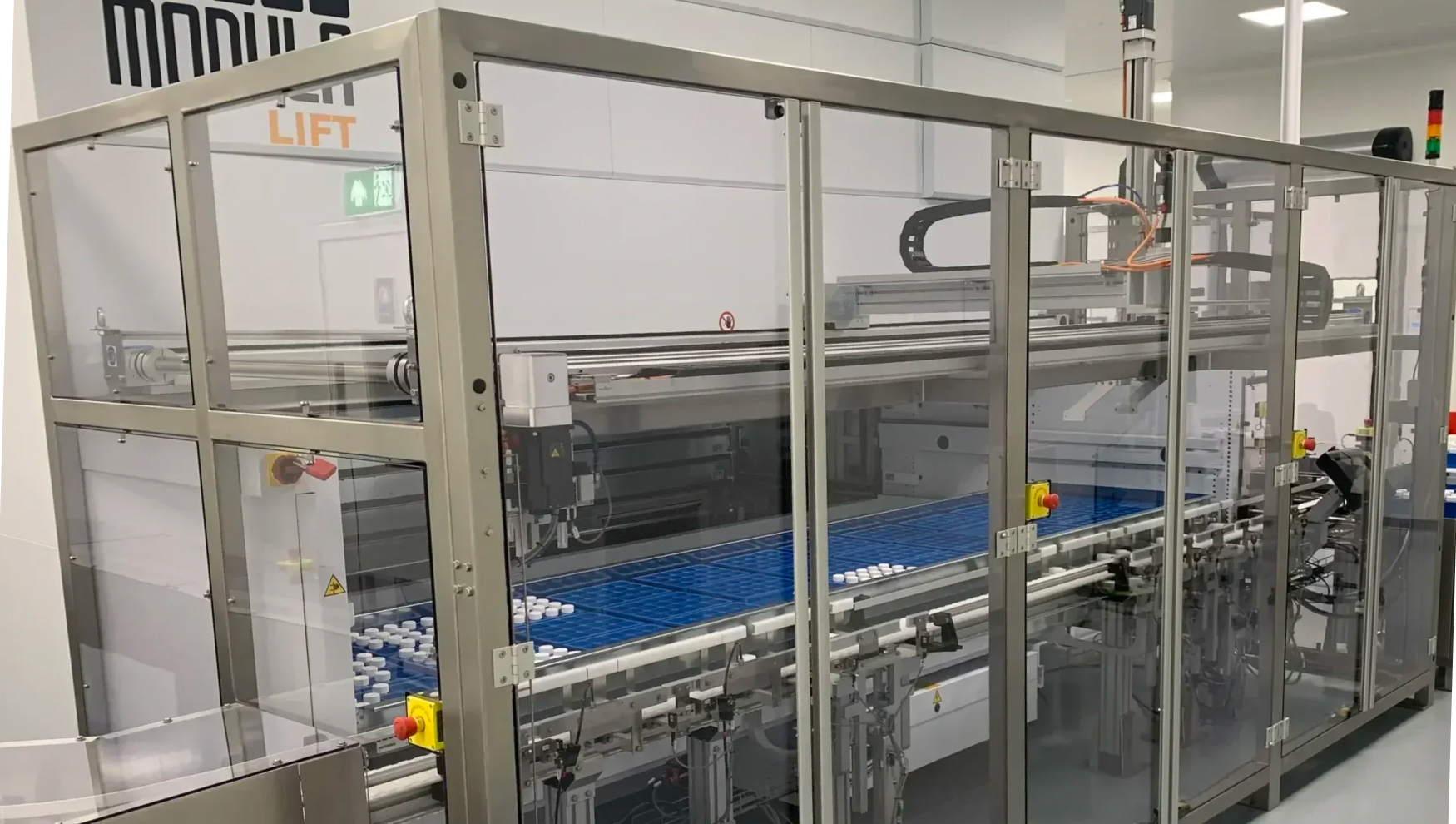
What does PACE comprise?
- Multiple drug types – currently supports tablets and capsules, with future types possible through new filling station development
- Modular filling station – easily removed for decontamination and reinserted to handle different drugs
- Automated in-line & camera-verified label printing – eliminate costly labeling mistakes
- Scalable architecture – increase bottle hopper capacity, filling stations and storage without redesigning the system
- Unique filling station design – allows multiple different drug types to be processed at the same time, in one cleanroom
- QP dashboard – a web-based interface for QPs to review verified data from each process step and authorize drug batch releases
| 1 | Bulk feeding and singulation |
| 2 | Weigh module 01 |
| 3 | Desiccant filling module |
| 4 | Weigh module 02 |
| 5 | Tablet filling modules |
| 6 | Capsule filling module |
| 7 | Weigh module 03 |
| 8 | Sealing and capping |
| 9 | Labeling |
| 10 | Storage and dispatch |
Why do pharma companies invest in PACE?
- Reduce lead time on clinical trials
- Get medicines to patients quicker
- Enable flexibility and complex clinical trials
- Increase productivity
- Reduce cost
- Minimize waste and CO2
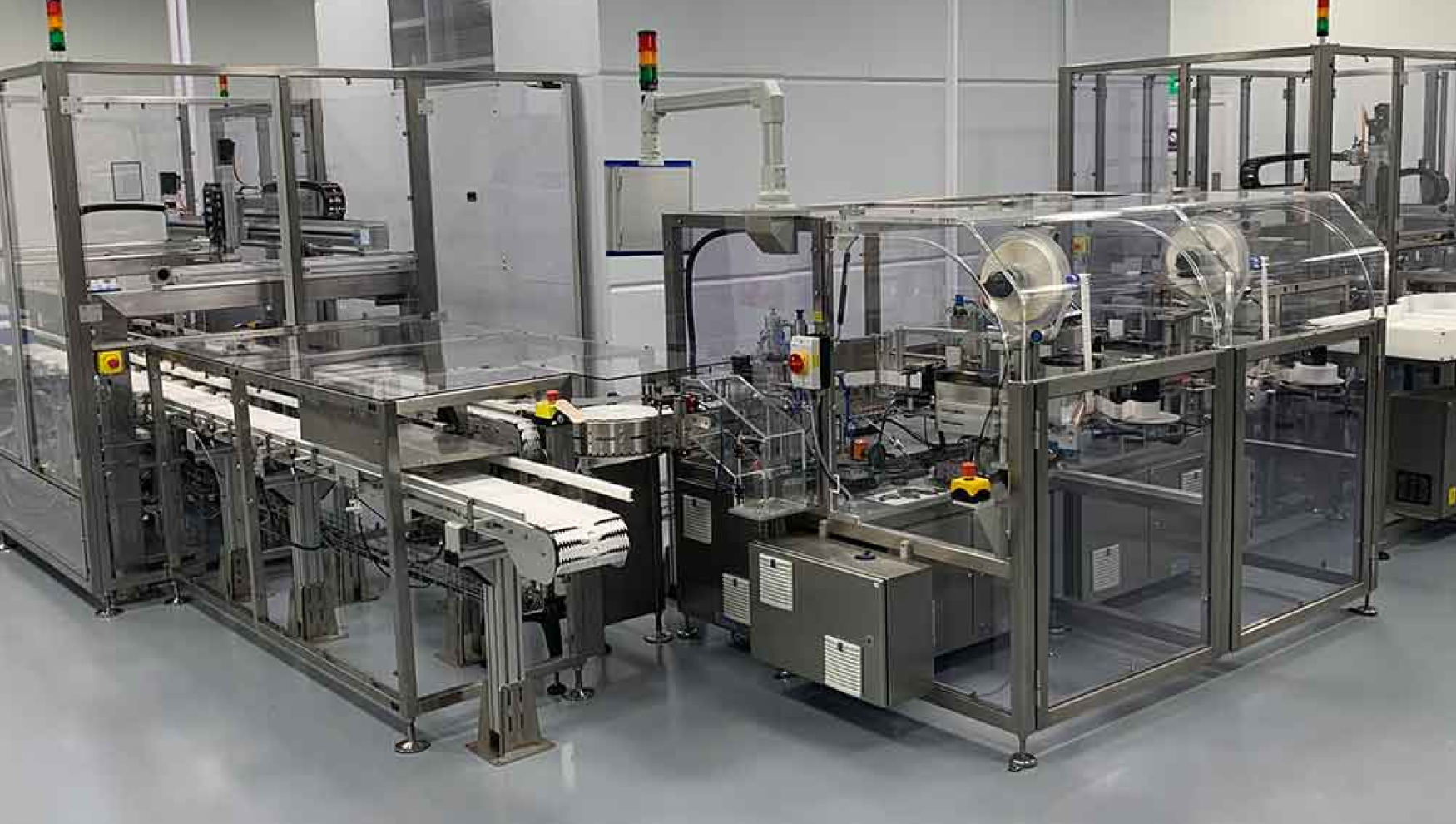
How PACE has been proven in practice
PACE has already been put to work as part of a ‘just-in-time’ clinical trials supply project at a UK medicines manufacturing innovation center, where it’s helping demonstrate a new supply model.
This could shrink trial supply timescales from months to days, while reducing the environmental cost of running parallel single-drug lines.
Where PACE is headed
PACE is still an early-stage platform, but it points to something bigger: a genuinely demand-driven clinical supply chain, where drug production responds to real trial need in real time rather than being planned months in advance.
As the platform develops, AIR is continuing to expand what it can process and how it integrates into wider trial supply operations.
Interested in how PACE could apply to your clinical trial supply chain? Get in touch with our pharma automation team.
FAQs
Yes, the PACE platform is designed to handle the production, packaging and labeling of multiple drugs within the same facility, ensuring complete traceability throughout the process.
Yes, the PACE system is designed to be flexible and can be adapted to meet various manufacturing requirements, including handling different sizes and types of products.
The key innovation is the patented design of the filling station which allows for a series of humidity and temperature-monitored drug filling stations to operate as fully independent units on a single line. This design prevents cross-contamination and facilitates quick changeovers between different pharmaceutical product types.
With the ability to pack multiple drug types and formats on a single line, the PACE platform reduces the need for multiple cleanrooms, streamlining operations and improving efficiency.
The system can process a range of product types and sizes, accommodating various label types to suit different customer needs.
By enabling quick reviews of verified data, the system allows QPs to efficiently assess and approve products for dispatch, resulting in faster delivery times.
Featured capabilities:
Related news & insights
The conversation among manufacturers has moved on from, “should we automate?” to “how do we automate?” Darragh de Stonndún, CEO of Automated Industrial Robotics, says there’s a right and a wrong...
You might have heard of build-to-print manufacturing. Here’s a comprehensive guide on what it is, when to use it, and how it differs from build to spec.

A Proven Approach for Semiconductor OEM Equipment Development