Flexible robotic workcell accelerates mobile device assembly development
Project snapshot
Client:
Location:
Sector:
Product type:
Challenge
Rapidly test multiple assembly processes with minimal capital investment
The development team needed to validate tight-tolerance assembly processes—including adhesive dispense, vision-aided alignment, cable insertion, and sequence testing—without the expense of building separate workcells for each process. Hard fixturing would have limited flexibility and slowed iteration on a changing product design.
Innovation
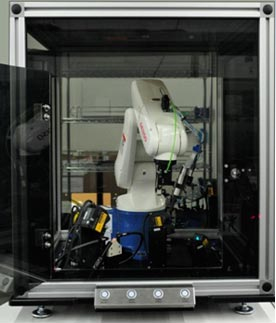
Multi-purpose, flexible robotic workcell
We delivered a small, adaptable robotic station to support rapid process experimentation and validation.
Key elements of the solution included:
- Small safety enclosure with a single robot capable of multiple end effectors.
- Quick-change tooling for adhesive dispensers, assembly gripping, on-end-effector vision, and other process fixtures.
- PC-based control with graphical user interface, data collection, and simple operation.
- Enabled the manufacturer’s team to validate processes and produce small product quantities for evaluation.
- Flexible platform that could be reused for multiple iterations of the product and later scaled into high-volume equipment.
Result
Validated assembly processes while minimizing equipment costs
The flexible workcell allowed the development team to confidently test and optimize assembly processes, providing proof of concept for high-volume production equipment without incurring the cost of multiple specialized workcells.
Featured capabilities:
Featured sectors:
Case studies
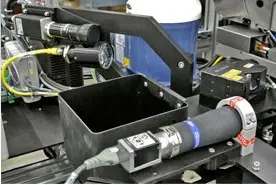
Assembly of a critical module required components to be aligned to micron-level precision relative to a reference axis. The surfaces were difficult to image, and in-process quality control (IPQC) was complicated…
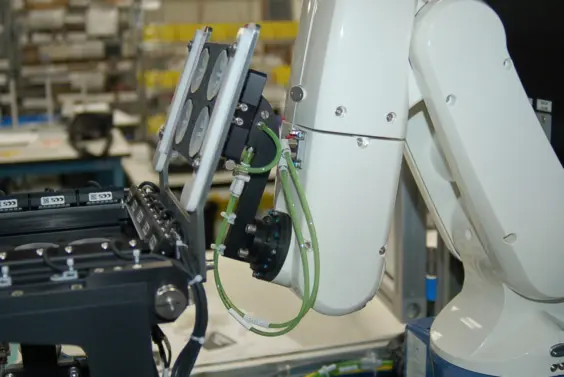
A next-generation tablet design required extremely precise alignment of the display to the back housing, a task the contract manufacturer was unable to solve with a passive alignment fixture. The process…
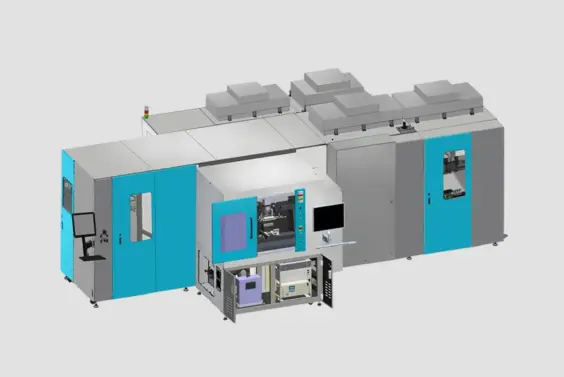
A battery manufacturing startup needed to rapidly increase manufacturing capacity to support customer sample ramp-up. A laser ablation process for a critical layer in the battery stack had been proven…