Scaled battery manufacturing with high-throughput laser processing automation
Project snapshot
Client:
Location:
Sector:
Product type:
Challenge
Industrialize a lab-based laser process for high-volume battery production
A battery manufacturing startup needed to rapidly increase manufacturing capacity to support customer sample ramp-up. A laser ablation process for a critical layer in the battery stack had been proven in the lab, but it needed to be refined and integrated into production-ready automation.
The challenge was to maximize throughput and laser utilization while handling thin, fragile materials across multiple form factors. The system also had to ensure precision, cleanliness, and reliability at manufacturing speeds.
Innovation
Laser process and automation engineered to work together
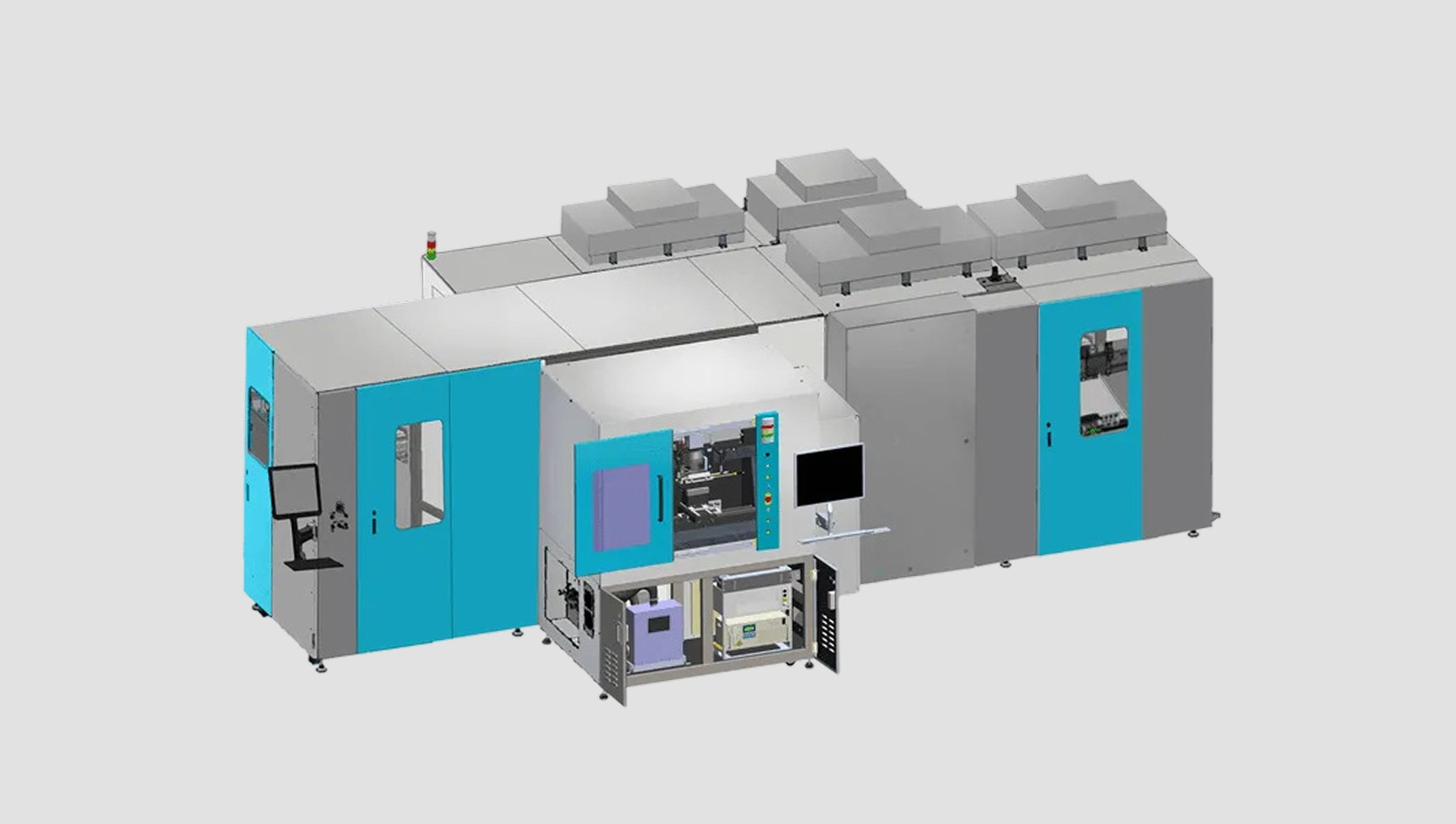
We partnered with Turner Laser Systems (TLS) to convert a lab-scale laser process into a production-ready, fully automated manufacturing solution.
Our approach focused on
- Optimizing the laser ablation process for quality, accuracy, and high-throughput manufacturing across multiple product formats.
- Designing a laser-compatible chuck to hold delicate layers flat and stable during processing.
- Integrating debris management and cleaning systems to ensure process cleanliness and yield.
- Developing automated handling to move thin, fragile layers quickly and reliably through the system.
- Combining TLS’s laser process expertise with our automation and manufacturing experience to deliver a turnkey solution.
Result
Production-ready automation accelerated battery sample ramp-up
This semi-custom laser platform was integrated quickly into a custom, fully automated system to handle and clean the delicate parts. The laser expertise of TLS and the manufacturing equipment experience of AIR delivered a complete solution to guarantee both the process and the automation worked together out of the box.
Featured capabilities:
Featured sectors:
Case studies
Assembly of a critical module required components to be aligned to micron-level precision relative to a reference axis. The surfaces were difficult to image, and in-process quality control (IPQC) was complicated…
A next-generation tablet design required extremely precise alignment of the display to the back housing, a task the contract manufacturer was unable to solve with a passive alignment fixture. The process…
The fragile PV cells required high-speed handling, inspection, and precise placement into custom carriers. Vision systems were needed at both input and output to detect defects and provide positional feedback….